Circular economy that delivers results
![[AI-generated] Kreisförmige Infografik zeigt den Recyclingprozess von Haushalten über Abholung zur Wiederverwertung](https://prezero.img.schwarz/dA1gEJkK8ve4uJ-R27Q2H0E-UCOxGGgZKM-_EpdXbtk/ai:t/dpr:1/h:315/rt:fill/w:896/aHR0cHM6Ly9wcmV6ZXJvLWNtcy5vYmplY3Quc3RvcmFnZS5ldTAxLm9uc3RhY2tpdC5jbG91ZC9wcmV6ZXJvL2ltYWdlcy8wLzMvNy80LzIzNjQ3MzAtNC1nZXItSU5ULzJlYzUyNDVjNWNkMC1QWl9JbnRfV2Vic2l0ZV9WaXN1YWxzX0NpcmN1bGFyX0Vjb25vbXlfSGVhZGVyLndlYnA)
Resource sovereignty has become a business imperative for companies that want to sustain their success.
Companies, industries, and municipalities that actively manage their material flows are better positioned to perform and compete in the years ahead.
The circular economy is more than an idea. It brings transparency to material flows, reduces dependencies, and helps keep resources in circulation — retaining their value for as long as possible.
We put these principles into practical, day-to-day operations — at industrial scale. We combine connected infrastructure, clear processes, and reliable data to deliver solutions that work today and in the future.
What does circular economy mean?
It means treating materials as assets, not consumables to be used once and forgotten. Raw materials stay in the loop, get processed, and go back into use — in a structured, systematic way. Instead of linear, single-use models, material flows become something you can plan, measure, and control.
It goes beyond simply returning materials into circulation. It’s about deliberate, traceable integration into new processes.
Three principles. One goal: keep value in circulation.
1. Reduce waste and emissions
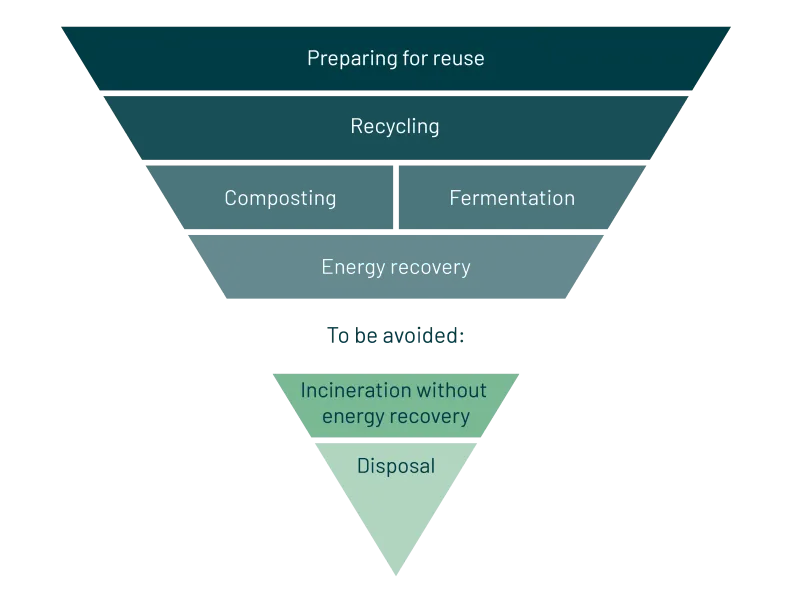
Circularity starts right where the loss of value begins. The Zero Waste vision doesn’t mean there will never be any waste. The goal is to systematically reduce avoidable loss of materials, keeping valuable resources in circulation, and steadily minimizing the volumes of residual waste.
The European waste hierarchy establishes a clear set of priorities: first reduce, then reuse or recycle, and recover energy last.
As regulations tighten and raw materials become harder to secure, this hierarchy becomes a practical basis for cost control, supply security, and competitiveness.
2. Keep materials in circulation
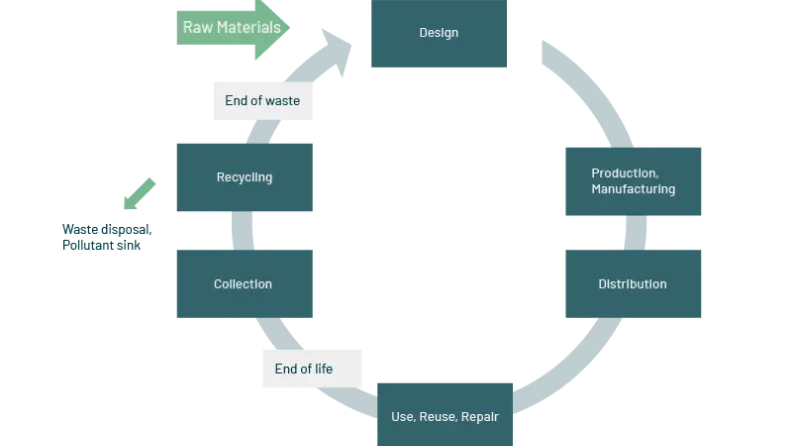
The circular economy keeps valuable resources in use through maintenance, reuse, repair, and reintroduction into production. Recycling is part of the system, but it’s not the starting point.
The material flow determines the right solution for each scarce resource. Battery recycling and electrical waste recycling, for instance, require different circular solutions from those used for aluminium or glass.
The aim is controlled reintegration into new production processes.
3. Retain value even when recycling isn’t an option
Not every material can be recycled, but its value can still be retained. When material recovery reaches its limits, energy recovery can help retain that value — using organic residues or non-recyclable fractions to produce electricity, heat, or biogas.
That keeps residual waste streams under control, which reduces landfilling and secures stable supply chains.
From a linear model to a controllable system
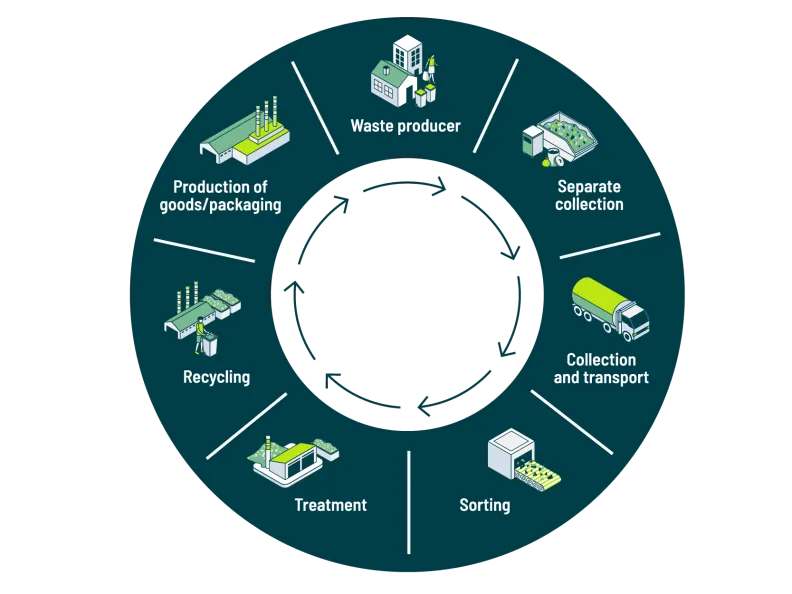
Linear models end at the end of a product’s life. Circular systems start right there. Materials are sourced, sorted, and processed, then fed back into industrial processes. Logistics, recycling, and the targeted use of recyclates become one interconnected system. The result is transparent material flows that can be measured, managed, and continually optimized.
Reliable data serves here as a solid foundation. Structured capture of material flows — linked to the right KPIs — makes them traceable and actionable. This serves as the foundation for reliable reporting, rigorous audits, and sound business decisions.
This gives companies clarity: from auditable documentation and transparency in Scope 3–relevant material flows to thorough preparation for regulatory requirements such as the PPWR (Packaging and Packaging Waste Regulation) or the Packaging Act. This facilitates informed investments and better procurement planning.
Circular economy as a sustainable economic model
It is an economic principle that helps companies manage material flows and use resources more intelligently.
It enables:
- Resource sovereignty by reducing dependence on primary raw materials
- More stable supply chains
- Confidence in regulatory compliance
- Predictable reduction of emissions
- Long-term competitiveness
With rising requirements, circularity becomes a key strategic factor in building resilience.
Circularity. Implemented by PreZero.
For us, the circular economy is more than a mission statement. It’s the essence of our daily operation, shaping how we approach everything we do.
PreZero designs, plans, and operates integrated circular systems across the entire value chain of manufacturing.
From capture, sorting, and processing through to return into industrial use – the entire framework is closely interconnected. While our vast infrastructure extends across Europe, our processes are clearly defined and built to scale.
Digital systems create transparency across material flows and enable reporting, verification, and management — even when requirements get complex.
Where others stitch together different individual services, we combine them in one unified system: operational delivery, reliable logistics, regulatory classification, digital documentation — and, where material recovery reaches its limits, energy recovery as the end-of-loop option.
This approach turns individual, isolated services into one coordinated framework. With material flows closely monitored and managed, and regulatory requirements systematically built in, otherwise scarce resources become reliably available.
Make circularity work for you
The circular economy shows its true impact when its core principles are effectively put to work in day-to-day operations.
We start by analyzing your material flows, reviewing regulatory requirements, and identifying where the real economic opportunities lie.
What you get:
- Full transparency across waste streams and material flows
- Assessment of recyclability and the potential to produce recyclates
- Structured classification of regulatory requirements
- Concrete measures, prioritized by economic impact
This turns complexity into a clear structure for planning and implementation.
In a free initial call, we review your starting point and define logical next steps.