Our climate strategy: Net Zero by 2050

Climate action and decarbonization are becoming key benchmarks for competitiveness and resilience.
As part of the Schwarz Group, PreZero doesn't treat sustainable business as a goal in itself. It is proactive risk management that protects our business models for the long term.
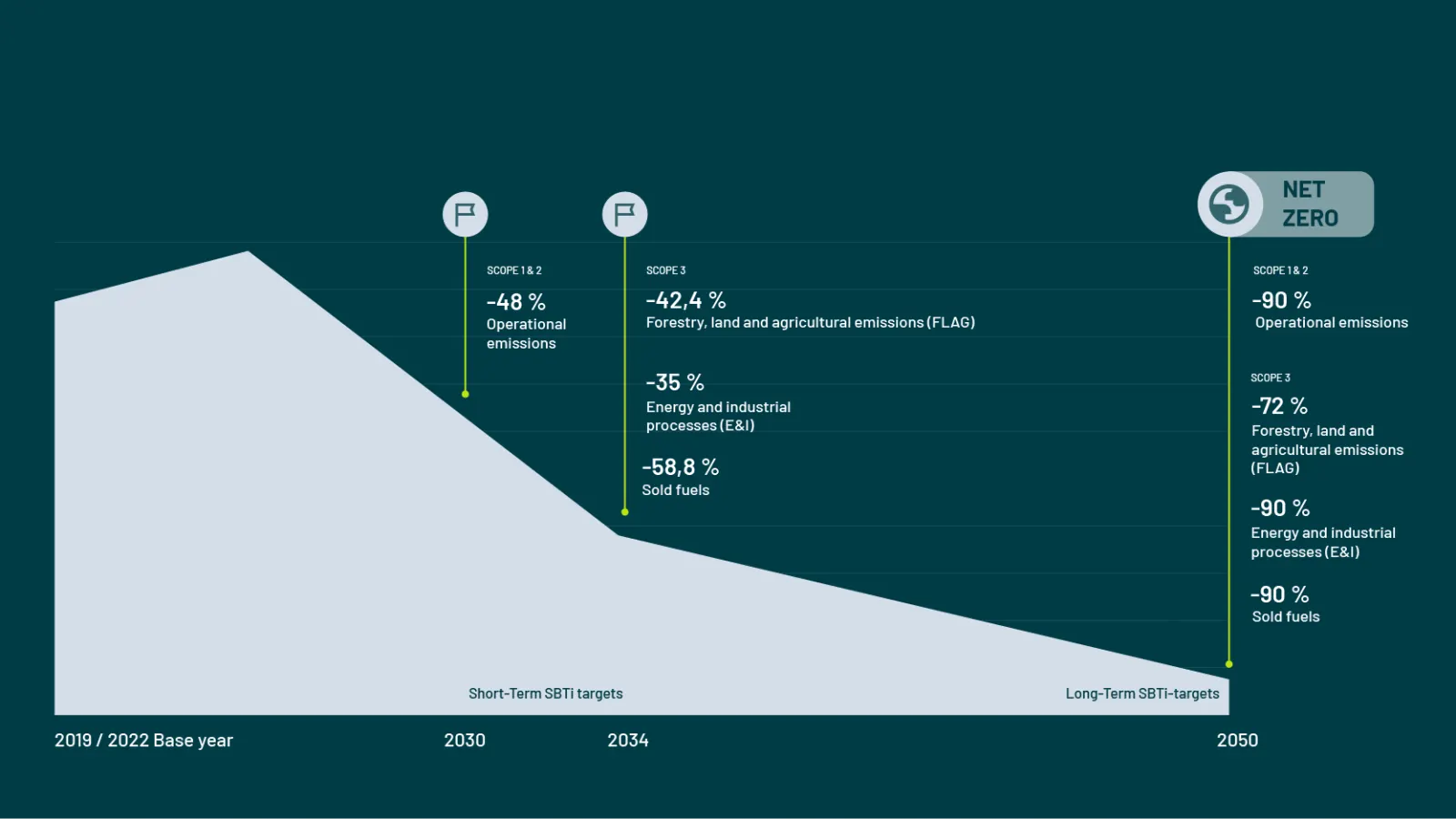
Our climate targets through 2050
As a global retail group with a responsibility to address climate change, the Schwarz Group companies have jointly committed to reaching net zero by 2050.
Together, they aim to reduce greenhouse gas emissions across the full value chain to net zero by 2050 at the latest.
To achieve this goal, the Schwarz Group companies have set short-term and long-term climate targets, validated by the Science Based Targets initiative (SBTi).
Net zero by 2050: SBTi-validated climate targets of the Schwarz Group companies
PreZero climate strategy
PreZero’s industrial profile gives it a different starting point then the other Schwarz Group companies. As an operator in the circular economy, we run energy-intensive facilities and logistics processes. This means some CO2e emissions are technically unavoidable because they arise directly from the treatment of waste.
Our contribution to the Schwarz Group companies’ net-zero target:
We are continuously working to lower our emissions and manage our growth in a way that minimizes additional emissions. Specifically, we aim to limit the growth of our own emissions (Scope 1 & 2) to a maximum of +20.5% compared to our 2019 baseline.
Avoided emissions through the circular economy
As a circular economy company, we manage material flows – from collection and sorting to recycling, composting, and the energy recovery of non-recyclable materials. These processes generate operational CO2 emissions, which are reported under Scope 1 and Scope 2.
Simultaneously, through recycling and material recovery, we reduce the demand for primary raw materials (naturally occurring substances extracted directly from the environment) and fossil energy. The use of secondary raw materials (materials recovered from waste through recycling) contributes significantly to emission avoidance.
In traditional carbon accounting, this contribution to avoided emissions only apperas indirectly, as decreasing Scope 3 emissions for our customers.
Putting our climate strategy into practice: How we’re making it happen
Our climate strategy is reflected in our day-to-day operations.
We reduce CO2e emissions across our own processes, especially in facilities, logistics, and energy generation.
Our most important levers are:
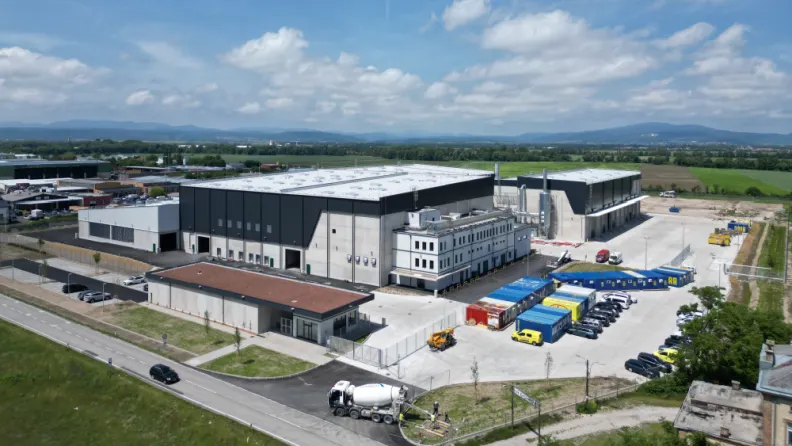
Energy-efficient facilities
We continuously improve energy efficiency of our facilities as part of our energy management.
This may include optimizing control and regulation technology, installing modern energy-efficient systems, expanding renewable energy sources, and utilizing waste heat generated by our technical facilities.
These measures aim to reduce our operational CO2e emissions reported in Scope 1.
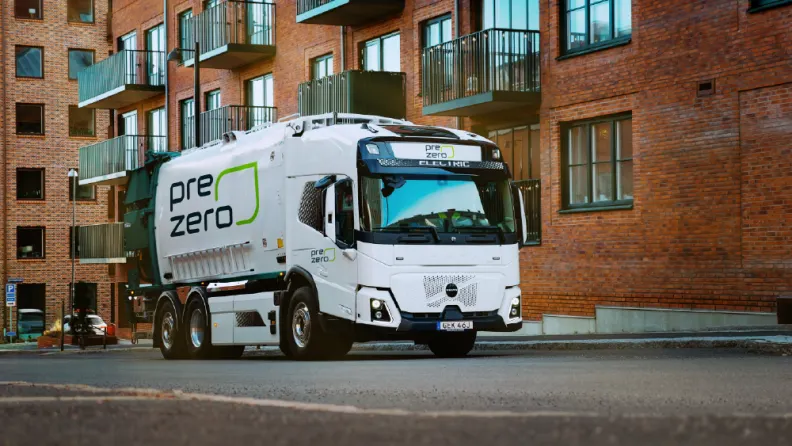
Modernizing logistics
One of our key levers is transport and collection logistics.
We reduce emissions through:
- the gradual expansion of our electric fleet
- the use of alternative fuels like HVO
- smarter route optimization
- training for fuel-efficient driving.
These measures target emissions from collection and transport.

![[AI-generated] PreZero Grafik zum Thema vermiedene Emissionen: Vergleich der CO2-Reduktion durch nachhaltige Kreislaufwirtschaft in Glaszylindern](https://prezero.img.schwarz/gddlylY8yv1ySLuR6Ui-Ndqy0vYW9IepTgpSbEqCIRI/ai:t/dpr:1/h:294/rt:fill/w:523/aHR0cHM6Ly9wcmV6ZXJvLWNtcy5vYmplY3Quc3RvcmFnZS5ldTAxLm9uc3RhY2tpdC5jbG91ZC9wcmV6ZXJvL2ltYWdlcy80LzEvNC8wLzI0MDA0MTQtMS1nZXItSU5UL2RkMTlkY2RmZmYxZC1QWl9JbnRfQXZvaWRlZF9FbWlzc2lvbnNfODAweDYwMC53ZWJw)
![[AI-generated] Eine abstrakte 3D-Illustration zum Thema Dekarbonisierung auf mintgrünem Hintergrund. Sie zeigt den Übergang von einem unteren, dunklen Ring mit schwarzen Molekülstrukturen (symbolisch für fossile Brennstoffe/CO2) hin zu einem oberen, leuchtend weißen Ring und einer schwebenden Lichtwolke mit einem kreisförmigen Pfeil, der den Prozess der Kreislaufwirtschaft und Reinigung darstellt](https://prezero.img.schwarz/Ua9j2zQwY4oxvg7QOtr-A2Vy8F6yiBz0YXPG0MfJu3I/ai:t/dpr:1/h:294/rt:fill/w:523/aHR0cHM6Ly9wcmV6ZXJvLWNtcy5vYmplY3Quc3RvcmFnZS5ldTAxLm9uc3RhY2tpdC5jbG91ZC9wcmV6ZXJvL2ltYWdlcy8xLzYvMy8wLzI0MDAzNjEtMi1nZXItSU5UL2I0MWQ4ZTE5ZDI4YS1QcmVaZXJvX0RlY2FyYm9uaXphdGlvbl9IZXJvLS53ZWJw)