Avoided Emissions

How the circular economy helps avoid CO₂ emissions
— and why standard corporate carbon accounting often fails to fully capture its impact.
Its biggest benefit to our environment comes from replacing energy-intensive virgin raw materials with circular solutions.
This applies to recycled materials that replace virgin raw materials or energy generated from organic waste instead of fossil fuels.
What are avoided emissions?
Avoided emissions are greenhouse gas emissions that never arise in the first place as thanks to circular processes such as recycling, reuse, or replacing fossil fuels with alternative sources of energy.
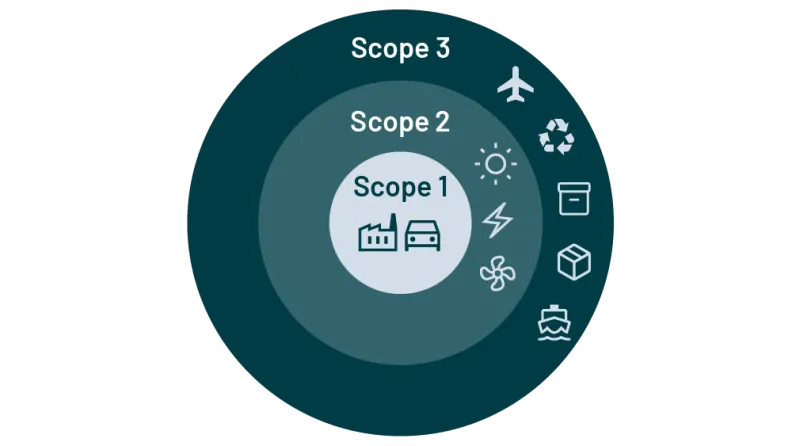
The accounting paradox of the circular economy
Traditional carbon accounting under Scope 1–3 measures the emissions generated throughout an entire company and its value chain.
For circular economy companies, that creates a structural challenge with two dimensions:
The visible burden
Waste collection, advanced sorting operations, and energy recovery from residual materials all involve industrial processes.
That means operational emissions — from logistics, energy consumption, and the thermal treatment of waste for energy generation.
Since conventional accounting only captures these emissions, this can make the sector look primarily like a source of CO₂ emissions rather than a solution.
The invisible contribution
What traditional accounting largely fails to capture is the true climate impact of these activities: avoiding the use of virgin raw materials and fossil energy through material substitution and energy recovery from waste.
That puts circular economy companies at a disadvantage simply because there is currently no recognized and auditable method for measuring the climate value they create across their operations.
Their positive impact on our environment — their “handprint” — cannot be properly attributed to them.
As a result, companies helping advance this transition to a more sustainable economy often remain overlooked.
If the transition from a linear to a circular economy is to accelerate, we need measurement tools that make the positive impact of circular solutions visible and encourage investment in the circular economy.
The solution: Setting an industry standard for calculating avoided emissions
To better quantify this systemic effect, we develope a methodology for calculating avoided emissions in the circular economy together with the ifeu Institute in Heidelberg and in consultation with international stakeholders.
It provides a solid foundation for showing that circular economy solutions make a meaningful contribution to emissions avoidance and climate protection.
That requires reliable data and a transparent methodology.
Our objective: building a stronger case for investment in circularity
Our aim is to establish avoided emissions as a reliable metric for the climate impact of circular solutions and, over time, help make it an industry standard.
Such a metric can help:
- make informed decisions about investment in terms of Sustainable Finance, ESG ratings, and the EU Taxonomy
- create a clearer framework for assessing the climate impact of circular business models
- make sustainable transformation measures easier to compare.
The result is an additional metric that makes the contribution of the circular economy to decarbonization more visible and creates incentives for investments in circular solutions.
Transparency is our top priority.

![[AI-generated] Eine abstrakte 3D-Illustration zum Thema Dekarbonisierung auf mintgrünem Hintergrund. Sie zeigt den Übergang von einem unteren, dunklen Ring mit schwarzen Molekülstrukturen (symbolisch für fossile Brennstoffe/CO2) hin zu einem oberen, leuchtend weißen Ring und einer schwebenden Lichtwolke mit einem kreisförmigen Pfeil, der den Prozess der Kreislaufwirtschaft und Reinigung darstellt](https://prezero.img.schwarz/Ua9j2zQwY4oxvg7QOtr-A2Vy8F6yiBz0YXPG0MfJu3I/ai:t/dpr:1/h:294/rt:fill/w:523/aHR0cHM6Ly9wcmV6ZXJvLWNtcy5vYmplY3Quc3RvcmFnZS5ldTAxLm9uc3RhY2tpdC5jbG91ZC9wcmV6ZXJvL2ltYWdlcy8xLzYvMy8wLzI0MDAzNjEtMi1nZXItSU5UL2I0MWQ4ZTE5ZDI4YS1QcmVaZXJvX0RlY2FyYm9uaXphdGlvbl9IZXJvLS53ZWJw)