Circular Economy for Sensitive Skin Care
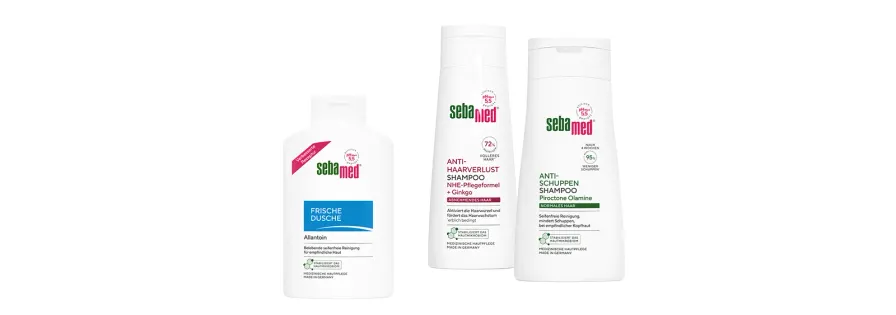
How sebamed Is Rethinking Recycling.
Sebapharma stands for high-quality medical skin and body care products, but that alone is no longer sufficient. After all, just like our skin, the packaging is much more than just a shell; it is crucial to the overall success of the product.
In collaboration with PreZero, the company is demonstrating how stringent hygiene requirements and ambitious recycling goals can go hand in hand. Without having to make any compromises.
1 The data is based on a calculation methodology (WasteEcoSavings) that has been developed by PreZero and specifically covers the processes of PreZero Dual GmbH. It complies with the scientifically recognized ISO 14040/44 standards. An external, critical review has also been conducted by the Institute for Energy and Environmental Research Heidelberg (ifeu).
The Challenge
Maintaining Color-Purity While Designing for Circularity.
The new EU Packaging and Packaging Waste Regulation (PPWR) sets out clear requirements: Starting in 2030, contact-sensitive plastic packaging — such as HDPE or PP — must contain at least 10% recycled material.
Considering these developments, Kathrin Bröder, engineer at Sebapharma, explains that it is becoming increasingly important for the company to optimize the recyclability of its packaging and the materials used.
What appears feasible at first glance is far more complex in practice, as there is zero room for risk when it comes to medical skin care. And this poses a particular challenge when it comes to the use of post-consumer recycled material (PCR): There must be no transfer of pollutants and no ink or odor residues. In other words, no compromises on quality or safety.
At the same time, the brand image has to be preserved. Above all, the iconic, pure white of the well-known sebamed products. This is where the real challenge lies: High-quality white rHDPE is scarce, expensive and hard to source.
Simply making a quick change in the purchasing process is not enough. What is needed is an approach that completely rethinks packaging design from scratch.
The Solution
“Circular Insurance”. Taking the Lead in the Circular Economy
Sebapharma and PreZero Dual have chosen a holistic approach that goes far beyond a conventional packaging licensing solution. A system participation agreement signed in early 2024 provides the foundation for their ongoing collaboration.
Through the innovative “Circular Insurance” concept, Sebapharma is securing early access to high-quality post-consumer recycled material (PCR) from PreZero Polymers, giving the company a real competitive edge.
PreZero serves as a key partner in the circular economy and provides all the relevant services from a single source: from materials procurement and system participation to practical implementation. A setup that not only works but is also scalable.
The Result
Ready for Tomorrow. Today.
The cooperation is working: Sebapharma is already meeting the future PPWR requirements for contact-sensitive plastics in parts of its range, without making any compromises whatsoever on quality or brand image.
Its hygiene standards remain as high as ever, and the familiar, pure white brand image of the sebamed products remains exactly that: pure white.

“Our collaboration with PreZero over the past two years has already been extremely productive, and it is very gratifying to know that our own packaging is being converted into recyclate to be reused across our product lines.
Kathrin Bröder, Dipl.-Ing. (TH) Environmental Protection;
at Sebapharma GmbH & Co.KG since 2018
Interview with Dipl.-Ing. Kathrin Bröder, Head of Packaging Development at Sebapharma.
She is responsible for developing the company’s packaging solutions – from primary containers to shipping units.
What makes your packaging at Sebapharma particularly special?
And what role does packaging play in your sustainability strategy?
Our packaging is characterized by a high level of whiteness, which represents both medical skin care and purity. Our goal is to create packaging for our medical skin care products that is both safe and aesthetically pleasing.
In addition, we are optimizing all our packaging to improve its recyclability, material usage and customer benefit. For us, being headquartered in the Upper Middle Rhine Valley UNESCO World Heritage site is both an incentive and an obligation that extends well beyond regulatory requirements.
When did you specifically start working on packaging made of recycled material, and how has PreZero been supporting your efforts?
It all started back in 2024 as the PPWR drew closer.
PreZero has been at our side, providing advice and support, right from the word go. There is a lot to do before 2030, from incorporating PCR material and ensuring recyclability to handling documentation.
PreZero provides rHDPE, which can then be used to make our primary containers. We have already successfully tested the compatibility of this packaging with a number of rinse-off products.
What do you particularly appreciate about the collaboration with PreZero?
PreZero provides informative webinars to help us implement these initiatives and moreover ensures that packaging engineers are on hand to advise us. We particularly value the strong collaboration that has been nurtured over the past two years and has proven extremely productive.
It is very rewarding to see that our own packaging can be converted back into recyclate to be reused across our product lines.
About Sebapharma
Sebapharma GmbH & Co. KG is the sales company for Sebamat GmbH, Herzpunkt Pharma GmbH, Maurer Pharma GmbH and Maurer Pharma Nord GmbH.
However, the story of our success goes back to 1967, when Heinz Maurer founded sebamat GmbH and launched the first soap-free cleansing bar with a skin-friendly pH of 5.5, revolutionising medicinal skin care. The name: sebamed.
Sebapharma is now active worldwide and currently employs 437 people.
With its globally recognised sebamed brand, Sebapharma stands for expertise, power of innovation and decades of entrepreneurial success.
About PreZero
PreZero is one of Europe’s leading partners for the circular economy. The company develops solutions that keep resources in the loop, reduce emissions, and turn waste into measurable value for businesses, municipalities, and communities.
Working with customers across sectors, PreZero helps strengthen resource sovereignty and supports decarbonization. Its comprehensive portfolio covers the full material cycle: from collection and sorting to recycling, energy recovery, and the supply of high-quality recycled materials.
Headquartered in Neckarsulm, Germany, PreZero is a company of Schwarz Group and employs around 30,000 people at 470 sites in ten countries across Europe.